
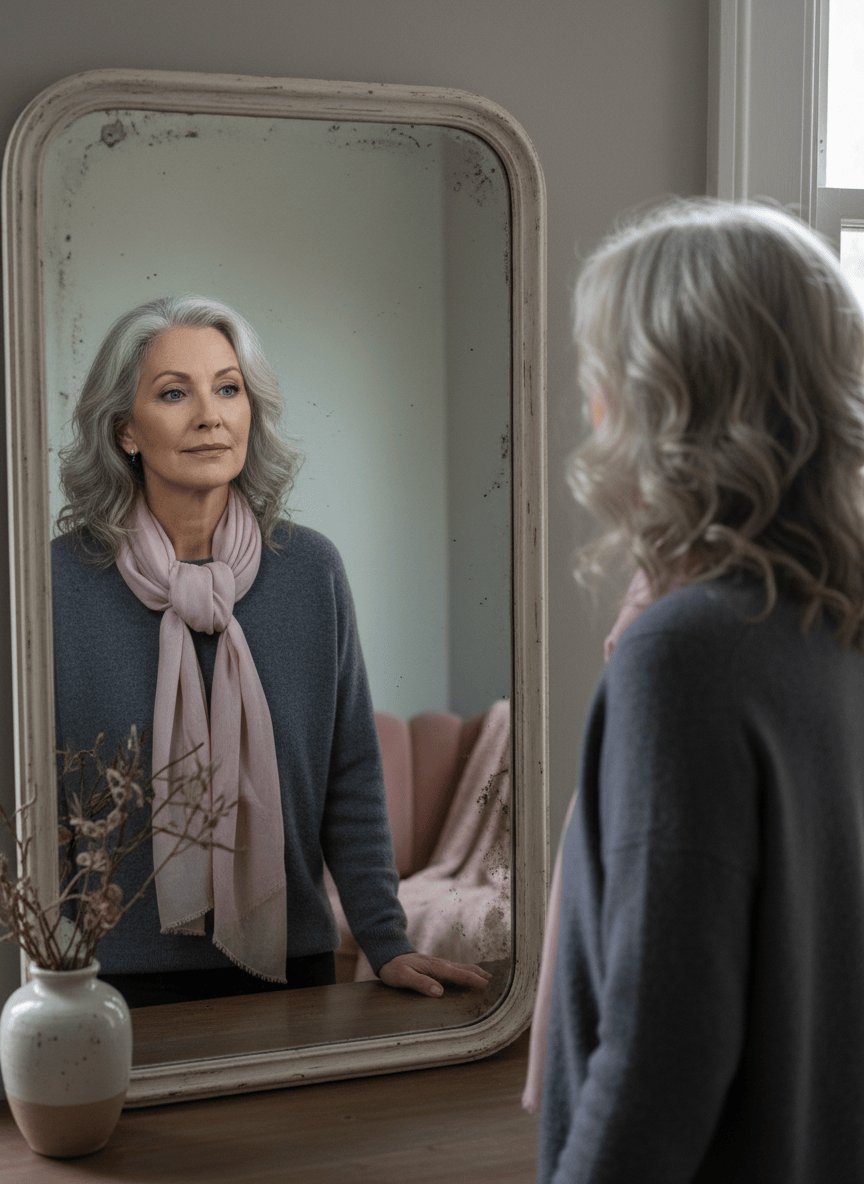
If the thing that got your attention was your hair, your skin, your nails, your body, or your face in the mirror, I am not going to make you invent a nobler reason for caring.
You noticed something changed.
Maybe your hair looks thinner. Your gray hair feels like somebody else’s hair. Your foundation suddenly sits on top of your skin instead of disappearing into it. Your nails keep splitting. Your clothes fit differently. You look tired when you do not feel tired.
And maybe your first thought was not, “I wonder what this tells me about healthy aging.”
Maybe it was, “What the hell happened?”
That Is Enough of a Reason to Ask
I use the word vanity on purpose because we tend to use it as a little slap on the wrist, especially with women.
You can care about your health, but do not care too much about how you look. Accept aging, but apparently prove that acceptance by becoming indifferent to your reflection. Take care of yourself, but make sure nobody thinks you are trying too hard.
I do not buy that bargain.
You can accept aging and still care how you look. You can understand that wrinkles, gray hair and changing skin are normal and still want a haircut that works, skin that feels comfortable, nails that stop catching on everything, or makeup that looks like you instead of sitting there announcing itself.
Those are legitimate outcomes.
Appearance Is Part of How We Experience Aging
This is not only a beauty-industry idea. Researchers studying adults in later life have looked at how perceived age, appearance, body image and self-presentation interact with the experience of aging. A 2024 study of U.S. adults ages 50 to 80 specifically examined appearance-related perceptions as part of people’s experience of aging. Qualitative research with older women has also found a meaningful distinction between appearance care and trying to conform to an imagined youthful ideal.
That distinction matters to me.
I am not interested in telling a woman she must look younger to be acceptable. I am interested in helping her look and feel like herself when the materials she is working with have changed.
Read the 2024 study on aging appearance and experiences of aging. Read the 2024 qualitative study on beauty work versus beauty care.
Sometimes Vanity Is the First Clue
This is where beauty and wellness begin to overlap for me.
A visible change does not diagnose what caused it. Hair thinning does not automatically tell me somebody is iron deficient. Dry skin does not automatically tell me what her hormones are doing. Brittle nails do not diagnose a nutrient deficiency. Looking tired is not a laboratory test.
But appearance can be the first place a person notices that the starting conditions changed.
Then the useful question becomes bigger:
- Did the hair fiber change, or are we dealing with shedding, breakage or density?
- Did skin become drier because the routine no longer fits, or is there something else that needs attention?
- Is the nail failing because of repeated mechanical stress, or is the pattern broader than that?
- Did sleep change?
- Food?
- Movement?
- Stress?
- Hormones?
- Medication?
- Illness?
- Environment?
- What does the timing tell us?
That is how vanity becomes a doorway without becoming a diagnosis.
I Am Not Going to Turn Every Beauty Question Into a Wellness Lecture
Sometimes the answer really is a haircut.
Sometimes the foundation formula no longer matches the skin underneath it. Sometimes a nail is tearing because it is too long for the repeated force landing on one corner. Sometimes your gray hair needs a different approach because it behaves differently from the pigmented hair around it.
I do not need to turn every ordinary cosmetic problem into mitochondrial dysfunction. 😂
But when the question legitimately opens outward, I will follow it. That may lead into food, exercise, sleep, oxidative stress, collagen biology, Nrf1 and Nrf2 signaling, NAD, the microbiome, mindset, products, or the point where the question belongs with a healthcare professional instead of me.
The subject changes. The method does not.
Start with what changed. Follow the pattern. Ask what the evidence earns. Then decide what belongs next.
Caring How You Look Does Not Cancel Self-Acceptance
I think we sometimes treat acceptance and action as opposites when they are not.
I can accept that my body is aging and still exercise. I can accept gray hair and still care whether the haircut makes it look good. I can accept skin texture and still moisturize it. I can accept a face with lines and still wear makeup because I like what color and light do for me.
Acceptance means I am not required to hate myself before I change something.
That is a very different proposition from giving up.
Why I Am Here
I am a cosmetologist. That is my professional front door.
I notice hair. I notice scalp. I notice skin and nails. I hear the complaint somebody uses before she has the technical language for what is happening.
Then I ask questions.
Sometimes the answer stays right there in cosmetology. Sometimes the visible change is the beginning of a larger conversation about how we age, what we can influence, what biology is doing, what products are worth considering, and what the evidence actually earns.
That is why I am comfortable using vanity as the doorway.
If how you look is what made you notice something changed, start there. We do not have to pretend you came in through a different door.
Next move: If something changed and you are not sure which question belongs first, Get the Answer. For the larger framework behind this way of thinking, read Practical Wellness and Who Is Lisa Proctor?

 Lisa Proctor